

How to Be a Great Shinkaizer
A practical guide to thriving as a Shinkai Ambassador
Being a Shinkaizer isn’t about being loud 24/7. It’s about being consistent, curious, and useful, helping more people discover what local-first AI agents can do, while giving Shinkai real signal from the field.
If you’re joining (or already inside) Ambassador Program 2.0, here’s what “being a great Shinkaizer” looks like in practice…week after week.
(If you haven’t read the official program page yet, start here: https://blog.shinkai.com/ambassador-program-2-0/)
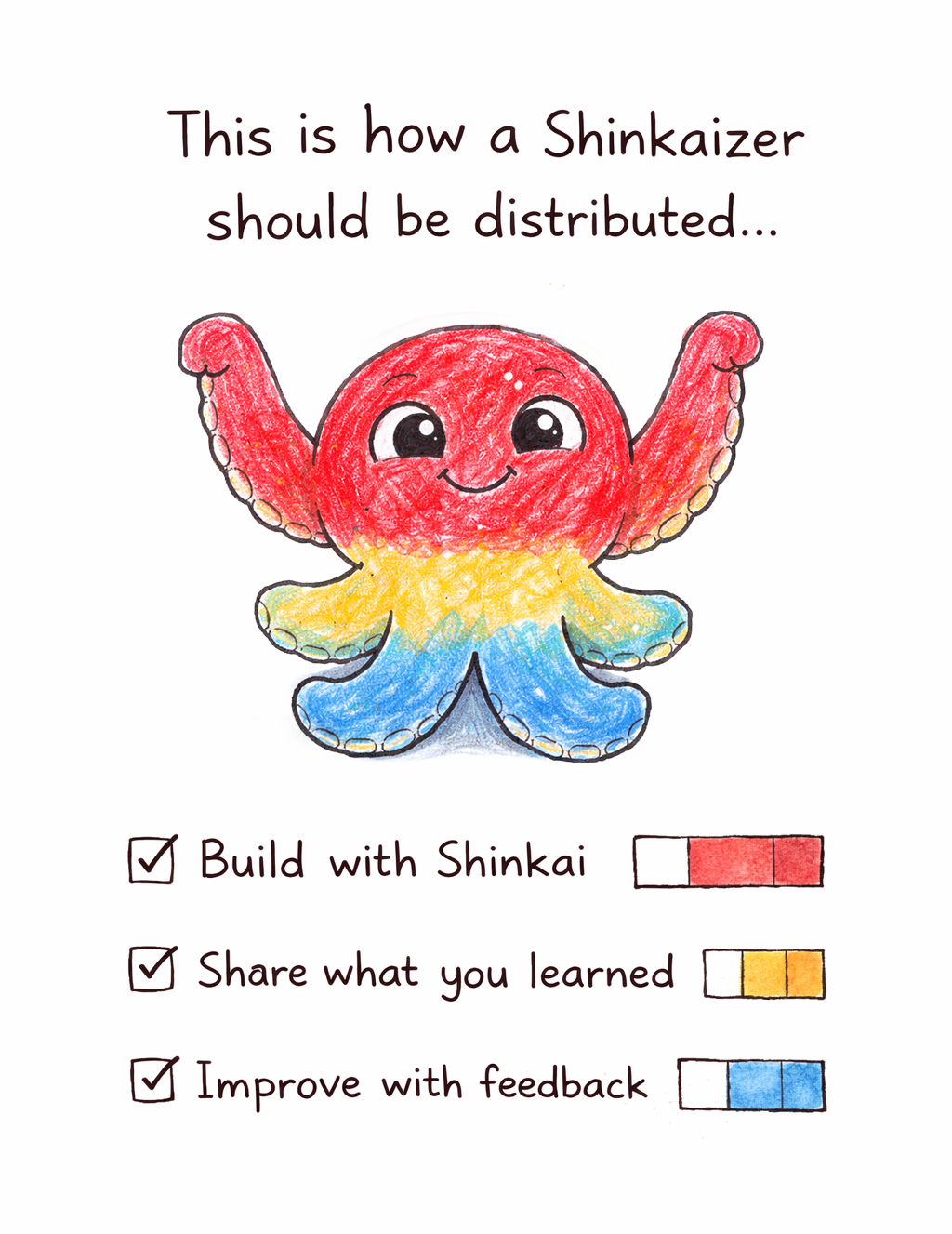
The Shinkaizer mindset: build, share, improve
The best ambassadors usually do three things repeatedly:
- Build something with Shinkai (agents, workflows, experiments)
- Share what they learned in public (so others can copy)
- Improve the product with feedback (so Shinkai gets better faster)
Everything below is just an expansion of that loop.
1) Do the quests like a pro (consistency > intensity)
Quests are designed to reward momentum. The best strategy isn’t doing everything once—it’s showing up every week.
What works:
- Pick 2–3 quests you can realistically complete weekly.
- Schedule a recurring time block (30–60 min) for “Shinkaizer ops”.
- Treat quests as prompts to ship something visible (post, agent, feedback).
Pro tip:
If you’re short on time, complete the quest and create one “public artifact” (a short post, screenshot, or a 20-second clip). That’s the multiplier.
2) Create agents people actually want to copy
The fastest way to grow as a Shinkaizer is to publish agents with clear outcomes.
Instead of:
“I made an agent that helps with research.”
Do this:
“I made a Daily Market Brief Agent that fetches X sources, summarizes 5 bullet points, and posts a structured update.”
A great agent share includes:
- Name (simple and memorable)
- What it does (one sentence)
- Inputs (what it needs from the user)
- Output format (what it returns)
- When to use it (who benefits)
- Optional: one screenshot/video of the result
Example agent ideas that perform well:
- Daily research assistant (AI/Web3/markets/news)
- “Summarize this PDF + extract action items” agent
- Trend scanner (X topics → signals + summaries)
- Product monitor (price changes, feature changes)
- Dev helper (repo overview, PR checklist, test plan generator)
3) Share your builds publicly (and make it easy for others)
If you build privately, you learn. If you share publicly, you lead.
Where to share:
- X (quick reach + discovery)
- Discord (community feedback + support)
- Short clips (the strongest conversion asset)
A simple weekly posting formula:
- Mon/Tue: “This week I’m building…”
- Wed/Thu: “Here’s the result + how it works”
- Fri/Sat: “Lessons learned / what broke / what I’d improve”
A template you can copy-paste
Post template (X):
Built a new Shinkai agent: [Agent Name] 🐙
It helps you [Outcome] in [time].
Inputs: [x]
Output: [format]
If you try it, reply with what you built 👇
Discord template:
I built [Agent Name] today 🐙
It does: [Outcome]
Here’s a screenshot + what I’d improve next.
Would anyone want a version for [use case]?
4) Be active in Discord
If X is where discovery happens, Discord is where momentum is built.
Being present in the Shinkai Discord is one of the most underrated advantages of the program—because it’s where you get:
- Fast feedback on your agents and ideas
- Direct access to community context (what people struggle with, what they want next)
- Quest clarity (what counts, how to submit, what works)
- Support and troubleshooting (so you don’t get stuck alone)
- Visibility with the team and other high-performing Shinkaizers
Most ambassadors who grow quickly do the same simple thing:
they don’t just post and leave—they participate, ask questions, help others, and share progress in Discord.
What “good Discord presence” looks like
You don’t need to be online all day. Just be consistent:
- Share your weekly build (agent + screenshot)
- Ask for one piece of feedback (“How would you improve this?”)
- Answer one question from a newcomer
- Drop one useful observation (bug, UX issue, improvement idea)
This creates a loop: you help the community → the community helps you → everyone ships faster.
5) Give feedback that actually helps the team ship faster
Ambassadors who give high-quality feedback become trusted voices quickly.
Great feedback looks like:
- What you tried
- What you expected
- What happened
- Why it matters
- How to reproduce
- Screenshots/logs (if possible)
A “gold standard” feedback message:
Feature: Scheduled Tasks
Expected: Run at 9:00 daily
Actual: Runs 5–10 min late sometimes
Impact: Breaks time-sensitive monitoring workflows
Steps: Create task → set daily 9:00 → observe 3 runs
Suggestion: Show last-run timestamp + retry policy
That’s the kind of feedback teams can act on immediately.
6) Help onboard others
You don’t need to answer everything—just help people take the next step.
Best onboarding behaviors:
- Share 1 helpful link + 1 simple next action
- Ask what they want to build (not what they “don’t understand”)
- Recommend one agent template to start with
Example:
“If you tell me your goal (research / content / dev / Web3 ops), I’ll suggest a starter agent you can build in 5 minutes.”
7) Be a community multiplier
The best Shinkaizers don’t just post—they amplify others.
Do this weekly:
- Repost a community build you like
- Reply to someone’s agent share with 1 improvement idea
- Collect 3 good community posts into one “weekly highlight” thread
That’s how you become a connector, not just a contributor.
8) The Shinkaizer weekly checklist
✅ Complete 2–3 quests
✅ Build 1 agent (or iterate one)
✅ Publish 1 post (X or Discord)
✅ Give 1 piece of structured feedback
✅ Help 1 person onboard (or answer 1 question)
✅ Amplify 1 community member
If you do that consistently, you’ll stand out fast.
What not to do (common mistakes)
❌ Spamming links with no context
❌ Posting only hype, no proof
❌ Building agents no one can reuse
❌ Feedback that’s vague (“it’s buggy”)
❌ Burning out trying to do everything
Consistency wins. Always.
The Local AI movement is growing because people want control: over data, tools, models, and workflows.
Shinkaizers are the ones proving—publicly—that this future works.
Build something real. Share it clearly. Improve it together.
That’s the path.
🐙 Your AI. Your Rules.